
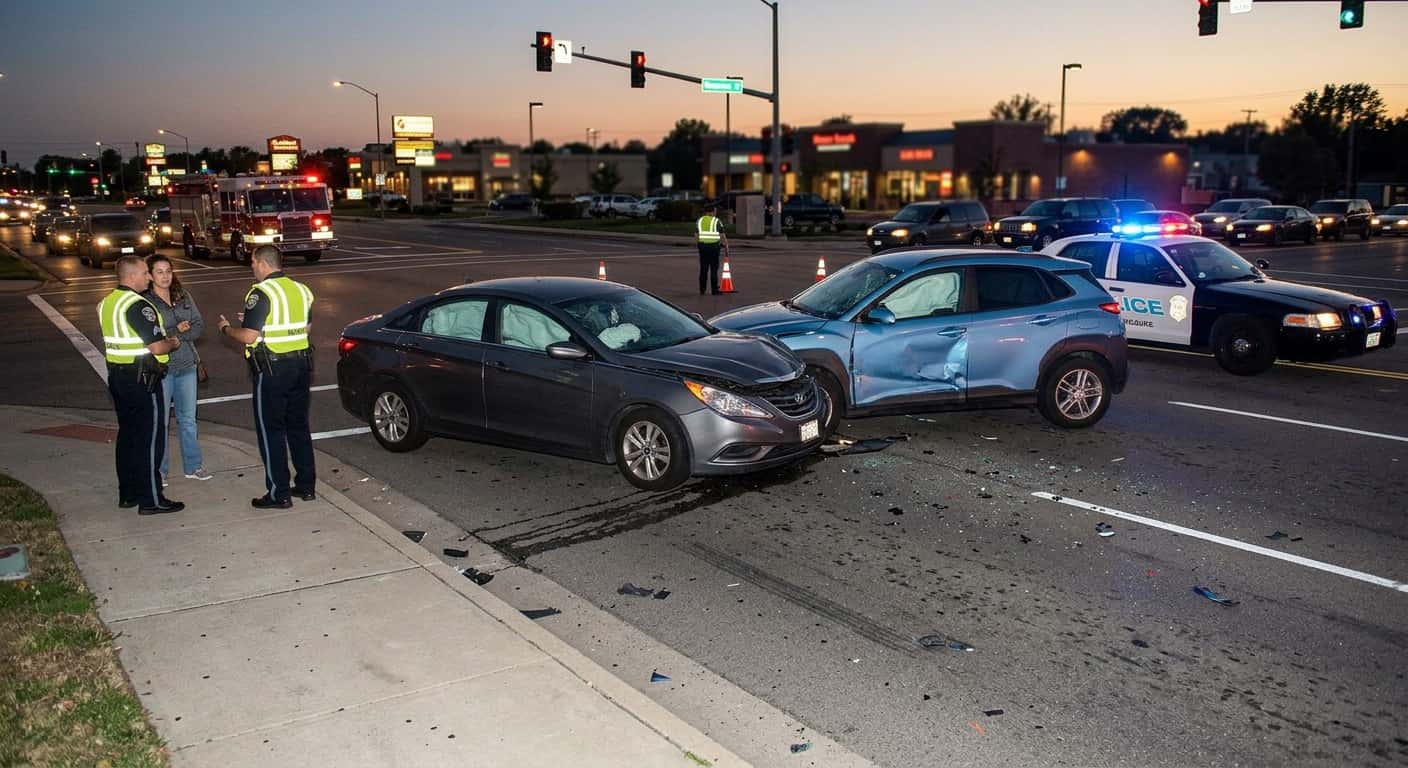
Crashes Around the I-270 / I-70 Interchange
If you commute through North County St. Louis, you already know how busy the I-270 and I-70 interchange gets. The combination of high merging traffic, the airport exit chaos, and the curving on-ramps from Lindbergh, St. Charles Rock Road, and Page sets up rear-end and sideswipe collisions.
Advanced Wellness Chiropractic is on St. Charles Rock Road in Bridgeton. We see auto accident patients who were driving the I-270 and I-70 corridor. This post covers what to do in the first 72 hours after a collision, why chiropractic care matters specifically for these injuries, and how the insurance side works.
The First 72 Hours After a Collision
What you do right after a car accident has a major impact on your recovery and on any insurance or legal claim that follows. The basics:
1. Report the accident and document the scene. Photos of vehicle damage, the position of the cars, debris, road conditions, and any injuries are useful for both insurance and medical purposes. The police report should include your statement.
2. Get evaluated, even if you feel okay. Whiplash and soft-tissue injuries often do not produce symptoms for 24 to 72 hours after the accident. The adrenaline of the moment masks early signs. By the time you wake up two days later with a stiff neck, severe back pain, or headaches, the inflammatory cascade is already in full swing. Getting evaluated within the first 72 hours documents the injury at its earliest stage, which matters for both treatment and any claim.
3. Save everything. Police report, medical records, photos, witness contact info, and any communication with the other driver or insurance carriers.
4. Be careful what you say to the other driver's insurance. They are not your advocate. A simple "I am okay" or "I feel fine" said in the moment can be used to deny later claims when symptoms emerge.
Why Chiropractic Care Is Particularly Suited to Auto Accident Injuries
The injuries you get in a typical low-to-moderate-speed collision are primarily soft tissue and joint injuries. The forces involved rapidly accelerate and decelerate your head, neck, and trunk, often beyond the normal range of motion of those structures. The result is the classic whiplash injury: damaged cervical facet joints, strained muscles and ligaments, irritated disc tissue, and sometimes mild concussion or vestibular symptoms.
These injuries do not show up on standard x-rays. They rarely show up on early MRI. They are real, they cause real pain and disability, and they are commonly treated with conservative care that addresses both the joint and soft-tissue components.
Chiropractic adjustments restore proper motion to the cervical and thoracic joints that were jarred out of normal function. Done gently and progressively (the acute phase is not the time for aggressive manipulation), adjustments help break the inflammation-stiffness cycle and accelerate recovery. Active Muscle Release addresses the muscle and fascia injuries that drive much of the lingering pain. Massage therapy supports the nervous system recovery that is critical after a whiplash event.
The patients who do best are the ones who start care early, stick with it for 4 to 8 weeks, and address all the components of the injury rather than chasing one symptom at a time. Read more on our car accident treatment service page.
Common Injury Patterns We See After Corridor Crashes
Many of the corridor crash patients we see were rear-ended. The injuries tend to fall into a few patterns:
Neck pain and headaches. The cervical spine takes the brunt of the rear-end mechanism. Patients describe pain at the base of the skull, headaches that radiate up over the head and behind the eyes, and limited range of motion turning the head. See our neck pain and headaches pages.
Mid and low back pain. The lumbar spine often takes a secondary hit from the trunk being whipped against the seatback and seat belt. Read more on low back pain.
Shoulder pain. Drivers especially get shoulder pain from gripping the wheel and from the seatbelt's diagonal compression. Rotator cuff strains and labral irritation are common. See shoulder pain.
Dizziness and vertigo. Some whiplash patients develop cervicogenic dizziness or BPPV from the head impact. See our vertigo page.
Rib pain. Particularly in seatbelted occupants. A focal sharp pain on deep breath after an accident is often a costovertebral joint subluxation. See rib pain.
Radiating arm or leg symptoms. If you have numbness, tingling, or weakness extending into a limb, we screen carefully for disc injury. See sciatica and pinched nerve.
How the Insurance Side Works
This is where most patients get confused. Payment depends on the available policy benefits, claim status, and any agreed billing arrangement, so ask how billing will work for your case before treatment begins.
MedPay is medical payments coverage. It is optional coverage that some auto policies include. Check your policy or ask your insurer whether you have it.
Health insurance may be an option for accident-related care. Call (636) 393-8390 to verify your plan's benefits.
The other driver's insurance. If another driver was involved, their insurer may be part of the claim. Claims can take time to resolve. An accident claim does not guarantee coverage or a zero balance.
Attorney involvement. If you are working with an attorney, tell us. Attorney or deferred-payment arrangements require individual review. They do not guarantee payment from a claim. We can provide records of your examination findings and the care you received.
We can help with records and billing questions. Call our office to discuss your specific situation and your responsibility before treatment begins. See also our workers comp page if your accident happened while on the job.
Drive Times to Our Bridgeton Office
Our office is on St. Charles Rock Road in Bridgeton, at 11520 St. Charles Rock Rd:
- Earth City: 8 minutes
- Hazelwood: 8 minutes
- St. Ann: 5 minutes
- Bridgeton: 2-5 minutes
- Florissant: 12 minutes
- Berkeley: 10 minutes
- Overland: 10 minutes
- Maryland Heights: 8 minutes
- St. Charles: 15 minutes
- Cottleville / O'Fallon: 22 minutes
Same-day appointments are often available Monday through Thursday afternoons. Call (636) 393-8390 to confirm.
When to Pick Up the Phone
Any of these should prompt a call within a few days of the accident:
- Neck pain or stiffness
- Headaches that started after the crash
- Back pain or stiffness
- Shoulder pain (especially from seatbelt diagonal)
- Sharp chest or rib pain with breathing
- Dizziness or balance changes
- Numbness or tingling in any limb
- Symptoms that improved briefly and came back
Red flags for emergency care: severe headache, loss of consciousness, vision changes, severe chest pain, severe abdominal pain, or symptoms suggestive of internal injury. Go to the ER first; we can pick up the soft tissue work afterward.
Schedule an appointment or call (636) 393-8390. We see accident patients who were driving the I-270 and I-70 corridor, and we can help with records and billing questions.

Related Articles
Chiropractic Care After a Car Accident: What You Need to Know
Been in a car accident in Bridgeton or St. Louis? Learn why seeing a chiropractor quickly matters, what to expect, and how insurance works. Call (636) 393-8390.
Auto AccidentsWhat to Do After a Car Accident: A Chiropractor's Guide
Been in a car accident near Bridgeton, MO? Learn what steps to take, why you should see a chiropractor, and how delayed symptoms can affect your claim.