New Aches During GLP-1 Weight Loss
You started Ozempic, Wegovy, Mounjaro, or Zepbound, and the weight is coming off. Then a new ache shows up. It often starts in the low back or one of the knees. Sometimes it shows up in the hips, the neck, or as a stiff shoulder that just will not loosen up. You did not fall, you did not lift anything heavy, but suddenly your body feels older than it used to.
A safety note first. We are a chiropractic office, not your prescriber. New or severe abdominal pain, persistent vomiting, or any other medication side effect should go to the provider who prescribes your medication, not to us. If symptoms are severe or you cannot reach your prescriber, go to urgent care or an emergency department, or call 911. Do not change or stop a prescription based on this article.
If this sounds familiar, you are not imagining it. At Advanced Wellness Chiropractic in Bridgeton, MO, we see patients who are losing significant weight on GLP-1 medications and notice new muscle and joint pain along the way. There are plausible mechanical reasons this can happen, and there are practical things you can do about it.
Why Joint Pain Can Show Up During Weight Loss
This article is about the mechanical side of losing weight, not about how the medication works. Questions about semaglutide (Ozempic, Wegovy), tirzepatide (Mounjaro, Zepbound), or any other prescription belong with your prescriber. What we can speak to is this: the body does not lose weight in a vacuum, and the way that weight comes off matters for your joints and muscles. The points below are our clinical reasoning, not findings from a drug study.
You can lose muscle along with fat. Weight loss can include some loss of muscle as well as fat. Muscle is what stabilizes your joints, supports your spine, and protects your low back when you bend, lift, or twist. When muscle is lost faster than your body can adapt, the joints that used to be well supported can become vulnerable.
Your biomechanics change rapidly. If you have been carrying extra weight for years, your body has built a movement pattern around it. Your hips, knees, ankles, and spine have all adapted to that load. When the weight comes off quickly, the alignment patterns and muscle compensations do not always catch up. Joints that were holding things together under load start moving in new ways, and pain can show up in places that never bothered you before.
Connective tissue takes time to remodel. Tendons, ligaments, and fascia are slow to adapt compared to muscle and fat. A rapid drop in body weight can change the load on these structures faster than they can adjust, which sometimes shows up as tendinopathy, fascial tightness, or joint stiffness.
The Most Common Pain Patterns We See
Patients on GLP-1 medications tend to come in with a handful of recurring complaints. Some of these may be related to the changes above, and some are old issues that finally surface as the protective muscle bulk thins out.
Low back pain is a common one. The lumbar spine relies heavily on the core, glutes, and deep stabilizers. As that musculature shrinks, old disc, joint, or alignment issues that were silent can flare up. Patients describe a deep ache after sitting or driving, morning stiffness that lasts an hour, or a sharp catch on bending. See our page on low back pain for the conditions we see most often.
Knee pain is another common one. The knee is essentially passive cartilage between two long bones, and it depends entirely on the muscles above and below it to track properly. Loss of quad strength and glute medius strength changes that tracking and often leads to patellofemoral irritation, IT band tension, or a vague ache around the kneecap. Our knee pain page covers the full picture.
Hip pain in the front of the hip or in the deep glute area shows up as the pelvis starts moving differently. Tight hip flexors that were buried under tissue suddenly feel obvious, and small misalignments at the SI joint become symptomatic. Read more on hip pain and how we approach it.
Shoulder and neck stiffness often comes from postural shifts. As the front of the body changes shape, posture shifts, and the upper back and neck compensate. Patients describe new headaches, a knot in one trapezius, or an arm that does not reach overhead like it used to.
Plantar foot and Achilles pain is less common but real. Losing weight changes how you land, and the plantar fascia and Achilles tendon are slow to remodel.
Where Chiropractic Care May Help
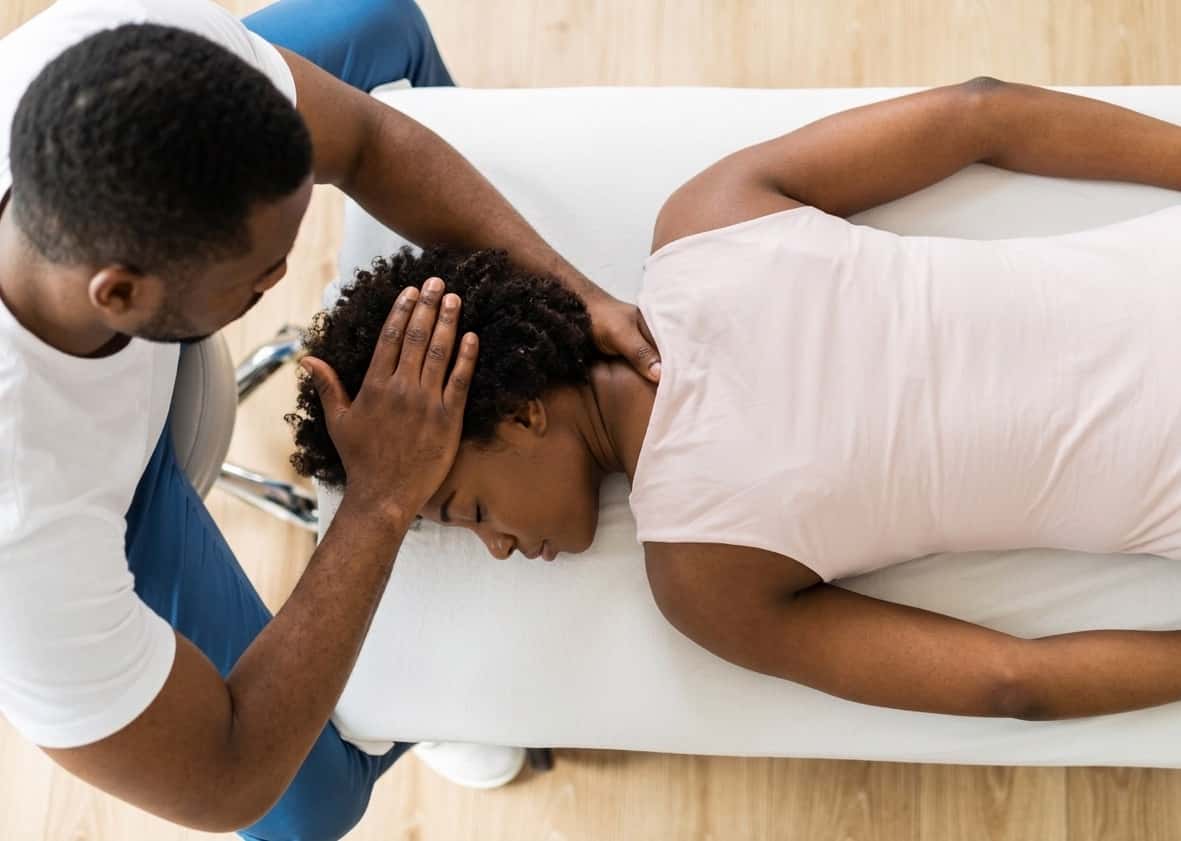
Chiropractic care may help when the pain is mechanical, meaning it comes from how your joints and muscles are moving as your body changes. An exam is how we sort that out. If something does not fit a muscle or joint pattern, we will refer you back to your prescriber or to another provider.
Chiropractic adjustments restore normal motion to joints that have become restricted or are tracking poorly. This is especially valuable in the low back and hips, where small alignment issues can drive a lot of pain. Restoring proper joint motion gives the surrounding muscles a chance to relax and the nervous system a clearer signal about what to do.
Active Muscle Release addresses the soft tissue side. As body composition shifts, fascia and muscle develop adhesions and trigger points that lock up movement. Active Muscle Release is hands-on work on these specific spots, paired with movement.
Graston Technique is helpful for the chronic tendon and fascia issues that sometimes develop as connective tissue tries to catch up with the rest of the body.
Massage therapy supports recovery, lowers stress on the nervous system, and helps the body adapt to its new shape. It is also a useful complement to the active care above.
What to Do at Home While You Are Losing Weight
Chiropractic care addresses the joint and soft tissue side, but there are things you can do yourself to make the transition easier on your body.
Keep up resistance training. Lifting weights at least twice a week gives your body a reason to keep muscle. Even if you cannot do much volume at first, two short sessions of squats, hinges, presses, and rows are better than nothing. If you have not lifted before, start with bodyweight squats, bridges, wall pushups, and resistance bands. For nutrition questions, including protein and fluids, ask your prescriber or a registered dietitian.
Walk every day. Walking is the simplest and most effective movement for keeping joints healthy. It loads the spine, hips, knees, and ankles gently and rhythmically, which is exactly what they need.
Stretch the front of your hips and the front of your chest. These are the two areas that get tight in nearly everyone who sits a lot, and the imbalance gets more obvious as you lose weight. Five minutes a day of basic hip flexor and chest stretches goes a long way. Our article on the best stretches for desk workers covers a routine that works for almost anyone.
Sleep well. Tissue remodels at night. Less sleep means slower adaptation.
When to See a Chiropractor
Mild aches that come and go can happen as your body adjusts. Pain that meets any of the following criteria is worth getting checked.
- Pain that has lasted more than two weeks without improving
- Pain that is interfering with sleep, work, or exercise
- Pain that radiates down a leg or arm
- Pain that started after a specific movement and has not resolved
New weakness, numbness in the groin, loss of bladder or bowel control, fever, or unexplained weight loss beyond what you expect from the medication need medical assessment, not a chiropractic visit.
The pain patterns in the list above are ones we see often, and an exam helps us sort out whether there is a mechanical cause we can address. A first visit at Advanced Wellness Chiropractic includes a thorough history, a movement and orthopedic exam, and a discussion of what is driving your pain and what to do about it.
You Are Not Doing Anything Wrong
If you have lost significant weight on a GLP-1 medication and your body is complaining about it, that does not mean you did something wrong. Your body is adapting, and adaptation is rarely smooth. Any decision about the medication itself belongs with your prescriber. Strength training, walking, and care for the joints and muscles that hurt can all be part of adapting well.
If you are in Bridgeton, St. Ann, Maryland Heights, Hazelwood, or anywhere in the greater St. Louis area and the joint pain that came along with your weight loss is starting to wear you down, we would love to help. Schedule an appointment or call (636) 393-8390 to set up a visit. We will examine you, explain what we find, and build a plan from there.

Related Articles
Back Pain After Mowing: Causes, Relief, and Warning Signs
Back pain after mowing or yard work? Learn what causes it, what helps during the first 48 hours, and when to see a Bridgeton chiropractor.
Pain ReliefSciatica: When to Call a Chiropractor vs. Go to the ER
Sciatica pain that won't quit? Most cases respond to chiropractic care, but a few warning signs mean head to the ER. Here is how to tell.
Pain ReliefChiropractic Care for Shoulder Pain in Bridgeton, MO
Shoulder pain interfering with daily life? Advanced Wellness Chiropractic in Bridgeton, MO offers drug-free treatment for rotator cuff, impingement, and more.