
The Complaint That Shows Up Every September
The lawn calls stop and the backpack calls start. Every fall, a few weeks after school goes back, parents in Bridgeton and Florissant start bringing kids in with the same thing: a sore neck, one achy shoulder, a middle back that hurts by the time the bus drops them off. The kid did not fall, did not get hurt in gym, did not do anything you can point to. They just started carrying a loaded backpack six hours a day.
It is easy to wave off, and most of the time it does settle down. But a heavy pack worn wrong, day after day, on a growing spine, is not nothing. The good news is that this is one of the most preventable problems I see all year. A few small changes to how the bag is packed and worn fixes most of it before it starts.
Why a Backpack Bothers a Growing Spine
A backpack is a weight hanging off the shoulders, and the body has to lean, brace, and compensate to carry it. Do that for a few minutes and nobody notices. Do it for hours a day, five days a week, on a frame that is still developing, and the compensations start to add up.
- Kids carry way more than they should. The rule most of us use is that a backpack should not weigh more than 10 to 15 percent of the child's body weight. For an 80-pound fourth grader, that is 8 to 12 pounds. It is genuinely common to see kids hauling a quarter of their body weight, which for that same child is 20 pounds of books, a Chromebook, a water bottle, and whatever lives at the bottom of the bag from last semester.
- The one-shoulder habit. Slinging the pack over a single shoulder looks cooler and wrecks the setup entirely. All the load lands on one side, the spine bends toward it to counterbalance, and the neck and upper back on that side stay tight to hold the position.
- The forward lean. A heavy pack pulls a kid backward, so they lean forward from the hips and poke the head forward to stay balanced. That forward-head posture is the same pattern I write about with phone use, and a backpack adds a full class day of it.
- Rushing. Kids swing these bags on and off, twist to grab them off the floor by one strap, and sprint for the bus with the pack bouncing. The load is not just heavy, it is heavy and moving.
None of this is dramatic on its own. Stacked across a semester, it is enough to leave a kid stiff, sore, and complaining.
Signs the Backpack Is the Problem
Kids are not great at describing pain, so you are often reading the clues. Watch for:
- A consistent complaint of neck, shoulder, or upper-back soreness on school days that eases on weekends
- Red marks or grooves on the shoulders after they take the pack off
- Leaning to one side, or struggling and grunting to get the bag on
- Tingling or numbness in the arms, which points to straps that are too tight and narrow
- Headaches that show up in the afternoon on school days
The weekend pattern is the tell. Pain that fades on Saturday and Sunday and comes back Monday is almost always load-related, not a random injury.
How to Set Up a Backpack the Right Way
This is the part that actually prevents the problem, and none of it costs anything.
- Weigh it once. Put the loaded bag on a bathroom scale, then weigh your child, and do the math. If it is over 15 percent of their weight, something comes out or goes in a locker. Parents are almost always surprised by the number.
- Both straps, every time. Non-negotiable. If your kid will not do it because of how it looks, that is a conversation worth having, because the one-shoulder habit is the single biggest offender.
- Tighten the straps so the bag rides high. The pack should sit against the upper and mid back, with the bottom no lower than the waistline. A bag sagging down by the backside pulls the shoulders back and down all day.
- Use the chest and waist straps if the bag has them. They move a chunk of the load off the shoulders and onto the trunk, where the body carries weight much better.
- Pack heavy things against the back. Books and the laptop go in the compartment closest to the spine, not out in the front pocket where they lever the load away from the body.
- Clean it out on Sundays. Half of what makes these bags heavy is stuff that does not need to be there. A weekly dump-and-repack keeps the weight honest.
For younger kids with a lot to carry, a rolling backpack is a legitimate option. The one catch is stairs and curbs, where they end up lifting the whole thing anyway, so it is not a fix for everyone.
When to Bring Your Child In
Most backpack soreness resolves once the setup is fixed. Bring your child to see us if:
- The pain has stuck around more than two weeks after you corrected the weight and the straps
- One shoulder or one side of the neck is consistently the problem
- There is numbness, tingling, or weakness in an arm or hand
- Your child is avoiding activities they normally like because of the pain
- You are noticing a posture change, like one shoulder sitting higher than the other
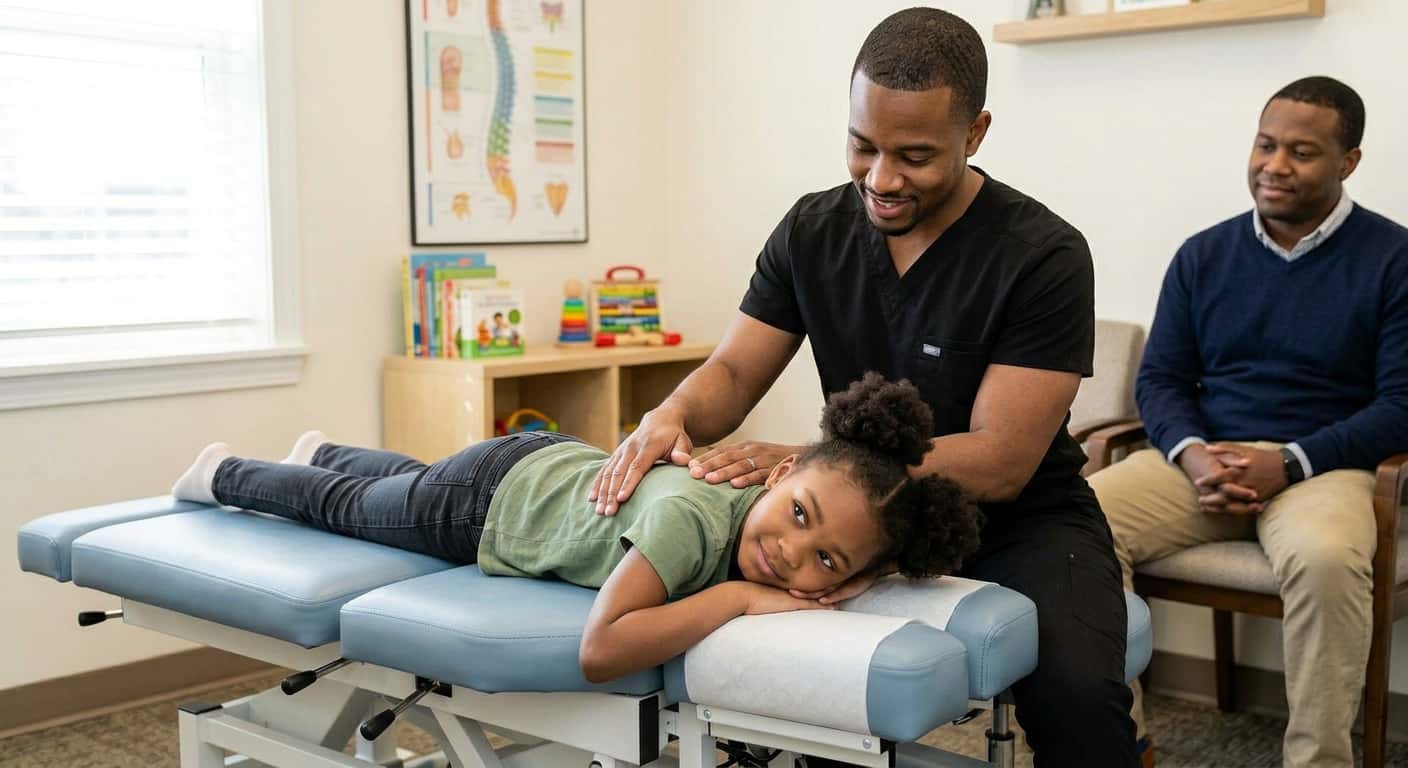
When a kid comes in for this, the visit is gentle and low-key. I check how they are moving, look at posture and how the spine and shoulders are tracking, and use light, age-appropriate chiropractic care to free up any joints that have gotten stiff from holding one position all day. Adjustments for kids are nothing like what you might picture from your own visits. They are gentle, and most kids think the whole thing is easy. If you are new to the idea of a child seeing a chiropractor at all, our post on whether chiropractic care is safe for kids walks through exactly how we approach it.
New patients can schedule a first visit, which covers the exam and, when it is appropriate, the first adjustment.
Backpack and Back-to-School FAQs
How much should a kid's backpack weigh?
No more than 10 to 15 percent of your child's body weight. For a 100-pound student, that is 10 to 15 pounds, loaded. If you have never weighed it, do it once. Most parents find the bag is heavier than they guessed.
Can a heavy backpack cause lasting damage to a child's spine?
For most kids, a heavy pack causes muscle soreness and posture strain rather than permanent damage, and it resolves once the load and the wearing habits are fixed. The reason to take it seriously is that a growing spine held in a bad position for hours a day, over years, is worth not gambling on when the fix is free.
Is a rolling backpack better for my kid's back?
For a child carrying a lot, a roller takes the load off the shoulders and back, which is a real benefit. The trade-off is stairs, curbs, and crowded halls, where they lift it anyway. It helps some kids a lot and others not much, depending on their school.
My child's backpack pain is only on one side. Should I worry?
One-sided pain usually means the bag is being worn on one shoulder or packed unevenly. Fix that first. If the pain stays on one side after a couple of weeks of wearing it correctly, that is worth an exam, because a joint on that side may have gotten stuck.
Serving North County's Students and Their Backs
We are at 11520 St. Charles Rock Rd in Bridgeton, a short drive for families in Florissant, Hazelwood, Maryland Heights, St. Ann, and Overland. If the new school year came with a new complaint, we are glad to take a look.
Schedule an appointment or call (636) 393-8390. Then go weigh that backpack. I promise it is heavier than you think.

Related Articles
Webster Technique: Questions Before Prenatal Chiropractic Care
Understand technique names, credential questions, and the limits of prenatal chiropractic care before arranging a visit in Bridgeton, Missouri.
Pediatric CareIs Chiropractic Care Safe for Kids? Questions to Ask First
Questions about pediatric chiropractic safety, treatment limits, and when a child needs medical care before a visit to our Bridgeton office.