
The Weight of Looking Down
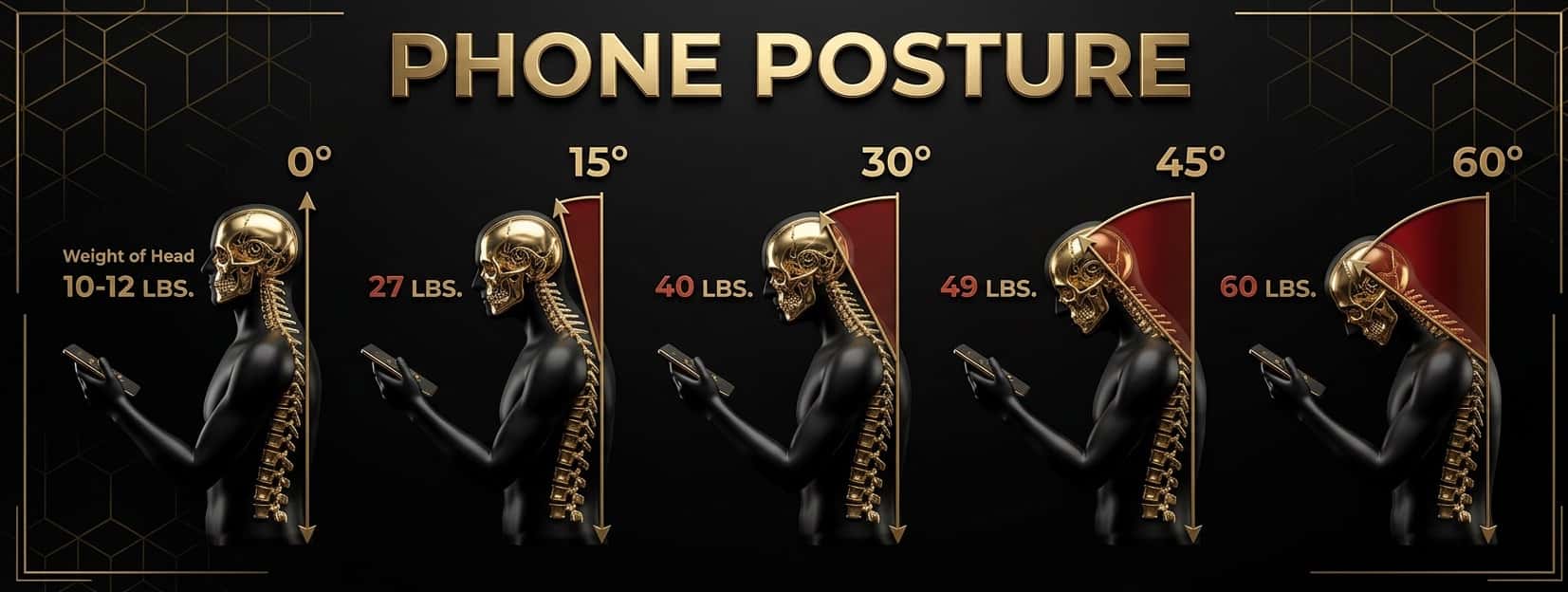
Your head weighs about 10 to 12 pounds when it is balanced directly over your spine. But for every inch your head moves forward, the effective weight on your neck increases dramatically. At a 45-degree angle, which is a common position when looking at a phone, your neck is supporting roughly 50 pounds of force.
A 2014 analysis by Dr. Kenneth Hansraj published in Surgical Technology International used a computer model of the cervical spine and calculated that at a 60-degree forward tilt, which is common when texting, the force on the neck reaches about 60 pounds.
Do that for hours every day and it is no surprise that neck pain has become one of the most common complaints we see at Advanced Wellness Chiropractic in Bridgeton, MO.
What Is Text Neck?
Text neck is a term used to describe the repetitive stress injury caused by looking down at a phone, tablet, or laptop for extended periods. It is not an official medical diagnosis, but the symptoms are very real:
- Persistent neck pain and stiffness
- Headaches that start at the base of the skull
- Upper back pain between the shoulder blades
- Shoulder pain and tightness
- Reduced range of motion when turning the head
- Tingling or numbness in the arms and hands
The average American spends over 4 hours per day on their phone. Over the course of a year, that adds up to more than 1,400 hours of forward head posture putting strain on the cervical spine.
Why It Gets Worse Over Time
The muscles at the back of the neck are designed to hold your head in an upright position. When you spend hours in a forward head posture, those muscles become overworked and fatigued. Meanwhile, the muscles at the front of the neck and chest become shortened and tight.
Over time, this imbalance can lead to:
- Loss of the cervical curve: The natural C-shaped curve in your neck begins to flatten or even reverse, which puts additional stress on the discs and joints
- Disc compression: Increased pressure on the front of the cervical discs can contribute to herniated discs and pinched nerves
- Chronic tension headaches: Tight suboccipital muscles at the base of the skull are a primary trigger for tension headaches, as we explore in our article on how chiropractic helps tension headaches
- Early degenerative changes: Abnormal loading on the cervical spine accelerates wear and tear on the joints
What You Can Do Right Now
Raise Your Screen
The simplest change you can make is bringing your phone up to eye level instead of dropping your chin to look at it. It feels awkward at first, but your neck will thank you.
Follow the 20-20-20 Rule
Every 20 minutes, look up from your screen for at least 20 seconds at something 20 feet away. This gives your neck muscles a break and reduces eye strain at the same time.
Chin Tucks
Sit or stand with good posture. Gently pull your chin straight back, as if making a double chin. Hold for 5 seconds and repeat 10 times. This exercise strengthens the deep cervical flexor muscles that support proper head position.
Stretch Your Chest
Stand in a doorway with your arms at 90 degrees on the door frame. Step forward gently until you feel a stretch across the front of your chest and shoulders. Hold for 30 seconds. Tight chest muscles pull the shoulders forward and contribute to forward head posture.
What the Research Says About Chiropractic Care for Neck Pain
A landmark randomized controlled trial published in the Annals of Internal Medicine (Bronfort et al., 2012) compared spinal manipulation, medication, and home exercise for acute and subacute neck pain. The study found that spinal manipulation was more effective than medication for both short-term and long-term pain relief. At 12 weeks, patients who received chiropractic adjustments reported significantly greater improvement than those treated with medication alone.
A Cochrane review published in Manual Therapy (Gross et al., 2010) found moderate quality evidence that cervical manipulation and mobilization produce similar effects on pain, function, and patient satisfaction at intermediate-term follow-up.
Evidence-based guidelines published in the Journal of Manipulative and Physiological Therapeutics (Bryans et al., 2014) made strong recommendations for treating chronic neck pain with manipulation, manual therapy, and exercise in combination with other modalities. This is consistent with the approach Dr. JC uses at Advanced Wellness Chiropractic.
How Chiropractic Care Helps
Self-care is important, but if you have been dealing with text neck symptoms for weeks or months, the structural changes in your spine likely need professional attention. At Advanced Wellness Chiropractic, Dr. JC takes a thorough approach:
Chiropractic Adjustments
Targeted adjustments to the cervical spine restore proper alignment and joint mobility. When the vertebrae in your neck are moving correctly, the muscles around them can relax and function normally.
Active Muscle Release
Active Muscle Release addresses the tight, shortened muscles in the front of the neck and chest while also treating trigger points in the upper trapezius and suboccipital muscles that contribute to headaches.
Graston Technique
Graston Technique uses specialized instruments to break down scar tissue and adhesions in the muscles and fascia of the neck and upper back. This is especially helpful for patients who have had chronic tension patterns for months or years.
Corrective Exercises
Dr. JC prescribes specific exercises to strengthen the muscles that support proper posture and stretch the ones that have become shortened. Our exercise guides include several movements specifically designed for neck pain and posture correction.
When to See a Chiropractor for Neck Pain
You should schedule an appointment if:
- Neck pain persists for more than a few days despite rest and self-care
- Pain radiates into the shoulders, arms, or hands
- You experience numbness or tingling
- Headaches are becoming more frequent
- You notice decreased range of motion when turning your head
Early intervention prevents minor postural issues from becoming chronic problems. The longer poor posture patterns continue, the more difficult they become to correct.
Take the First Step
If phone use and screen time have left you with persistent neck pain, stiffness, or headaches, we can help. Remote workers dealing with similar issues should also read our guide on how working from home affects your back. Contact Advanced Wellness Chiropractic in Bridgeton, MO at (636) 393-8390 to schedule an appointment. Not sure if your symptoms need chiropractic care? Take our Pain Quiz for a quick assessment.

Related Articles
Back Pain After Mowing: Causes, Relief, and Warning Signs
Back pain after mowing or yard work? Learn what causes it, what helps during the first 48 hours, and when to see a Bridgeton chiropractor.
Pain ReliefGLP-1 Joint Pain: Causes and Chiropractic Care
New back, knee, or joint pain while taking a GLP-1 medication? Learn possible causes and how chiropractic care may help in Bridgeton, Missouri.
Pain ReliefSciatica: When to Call a Chiropractor vs. Go to the ER
Sciatica pain that won't quit? Most cases respond to chiropractic care, but a few warning signs mean head to the ER. Here is how to tell.